

April 13, 2026
Introduction
Of all Morocco’s great cities, Fes is the one that most consistently overwhelms visitors — not with size or noise, but with depth. The medina of Fes el-Bali is the largest and best-preserved medieval Islamic city in the world, a UNESCO World Heritage Site of staggering complexity and beauty, where over 150,000 people live and work today in conditions and rhythms that have changed remarkably little over the past thousand years.
To walk into Fes medina without preparation is to be immediately, gloriously lost — not just geographically, but historically and sensorially. The sounds, smells, and visual density of the place are unlike anything else in Morocco, or anywhere else.
This guide gives you the preparation you need to experience Fes properly, efficiently, and deeply.
A Brief History of Fes
Fes was founded in approximately 789 AD by Idris I, the founder of the Idrisid dynasty and Morocco’s first Arab ruling family. The city grew rapidly under his son Idris II, who made it the capital of the emerging Moroccan state and presided over a period of extraordinary urban development that attracted scholars, craftsmen, and merchants from across the Islamic world.
By the 9th century, Fes had two distinct settlements — Adouat Al Andalus, founded by refugees from Córdoba in Muslim Spain, and Adouat Al Qarawiyyin, founded by refugees from Kairouan in Tunisia — each with its own mosque, market, and character. The two settlements eventually merged into the unified medina we know today.
The University of al-Qarawiyyin, founded in 859 AD within the Great Mosque, is widely recognized as the oldest continuously operating university in the world — predating Oxford, Bologna, and all the great European universities by centuries. Fes was for much of the medieval period one of the largest cities on earth and the undisputed intellectual, spiritual, and political capital of Morocco.
Understanding the Structure of Fes
Fes consists of three distinct areas:
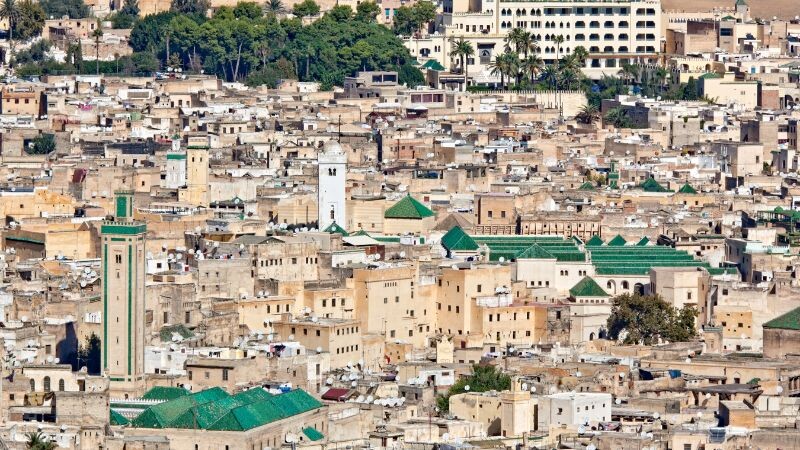
Fes el-Bali (Old Fes) — the medieval medina, the UNESCO World Heritage Site, and the reason everyone comes to Fes. This is the labyrinthine city of souks, mosques, madrasas, tanneries, and hammams that has existed largely unchanged since the medieval period. It contains approximately 9,000 alleyways, most of which are too narrow for any wheeled vehicle larger than a donkey cart.
Fes el-Jdid (New Fes) — actually built in the 13th century by the Marinid dynasty, making it several centuries old itself. This area contains the Royal Palace (exterior only — it is a working royal residence), the Mellah (Jewish Quarter), and a number of historic mosques and gardens. It bridges architecturally between the ancient medina and the modern city.
Ville Nouvelle — the French colonial city built in the early 20th century outside the medina walls, with wide boulevards, European-style cafés, banks, and modern hotels. Most guided tours are based here or on the medina’s edge.
The Top Things to See in Fes Medina
The Chouara Tanneries
No single image captures Fes as completely as the view from the leather shops above the Chouara Tanneries — the ancient open-air vats of colored dye where leather has been processed using the same techniques since the 11th century. The circular stone vats are filled with natural dyes — saffron for yellow, indigo for blue, poppy for red, henna for orange, cedar bark for brown — and workers stand knee-deep in them, treading the leather through the dye baths as their predecessors have for a thousand years.
The smell is powerful — the white vats contain pigeon excrement used to soften the leather, and nothing prepares you entirely for it, though the sprigs of fresh mint pressed into your hands by the shop owners as you enter help considerably. The view, however, is so arresting that even the smell quickly becomes part of the experience rather than a distraction from it.
Practical tip: Access the view only through the surrounding leather shops — you’ll be shown to the rooftop balcony, you don’t have to buy anything, though the leather goods here are genuinely some of the finest in Morocco.
The Bou Inania Medersa
Built between 1350 and 1357 by the Marinid sultan Bou Inan, the Bou Inania Medersa is one of the finest examples of Moroccan Islamic architecture in existence. The interior courtyard is a masterwork of carved cedar, sculpted plaster, and hand-laid zellij tilework — three materials and three craft traditions at the absolute apex of their expression. Students once studied Quranic science here; today it is open to non-Muslim visitors and the courtyard’s proportions and ornamentation are among the most beautiful spaces in all of Morocco.
Open daily; small entrance fee.
The Al-Attarine Medersa
Adjacent to the Qarawiyyin Mosque, the Al-Attarine Medersa (Medersa of the Spice Sellers) is another Marinid-era masterpiece of architectural decoration, named for the spice souk that surrounds it. The carved cedar screens of the upper gallery, the stalactite (muqarnas) ceilings of the doorways, and the proportions of the central courtyard are extraordinary. On a quiet morning, it is one of the most contemplative spaces in Morocco.
The Qarawiyyin Mosque and University
The al-Qarawiyyin Mosque at the heart of Fes el-Bali is the largest mosque in Africa, with a capacity of over 20,000 worshippers. Non-Muslims cannot enter the mosque itself but can glimpse the interior through the various doorways and gates that open onto surrounding alleyways — the carved cedar doors, the forest of carved plaster columns, and the courtyard fountains visible through the gateways are arresting even in partial view.
The attached University of al-Qarawiyyin is recognized by UNESCO and the Guinness Book of World Records as the oldest continuously operating university in the world.
The Nejjarine Fountain and Fondouk
The Nejjarine Fountain — an 18th-century tiled public fountain in the heart of the woodworking souk — is one of Fes’s most photographed corners, its zellige tilework and carved plaster canopy in a state of beautiful preservation. The adjacent Fondouk Nejjarine, a restored caravanserai (merchant’s inn) now housing a woodwork museum, is worth the entrance fee for the architecture of its three-story galleried courtyard alone.
The Mellah (Jewish Quarter)
The Mellah of Fes, located in Fes el-Jdid, is one of the oldest Jewish quarters in North Africa, established in the 14th century. At its peak it housed tens of thousands of Jewish residents; today the community is almost entirely gone (most emigrated to Israel after 1948), but the architecture — the distinctive overhanging wooden balconies, the Hebrew inscriptions above doorways, the Ibn Danan synagogue — preserves the physical memory of one of Morocco’s most important minority communities.
Practical Information for Visiting Fes
Getting there: Fes has its own international airport with connections to European cities. Alternatively, Fes is the endpoint of our 4 Day Tour from Marrakech to Fes via Sahara and 6 Day Morocco Tour from Marrakech, both of which deliver you directly to the medina.
Getting around: Fes medina is pedestrian-only. Taxis can bring you to the main medina gates (Bab Bou Jeloud is the most used) but not inside. For your first visit, a local guide is strongly recommended — not just for navigation but for the layers of history, craft knowledge, and community connection a good guide provides.
Best time to visit: Year-round, but March–May and September–November offer the most comfortable weather. Summer is hot but Fes medina’s narrow shaded alleyways stay relatively cool. Ramadan is a particularly atmospheric time to visit — the medina is quieter during the day and explodes into life at sunset for Iftar.
How long do you need? A minimum of one full day for the highlights. Two days allows a more relaxed exploration including the Mellah, the pottery quarter, and the hammam experience. Our 6 Day Morocco Tour dedicates a full day to Fes, which is the right amount for a first visit.
Where to stay: A riad in Fes el-Bali is the only way to stay. Waking up inside the medina — hearing the call to prayer echo between the walls, smelling the bread bakeries firing up before dawn — is intrinsic to the Fes experience and no modern hotel in the Ville Nouvelle can replicate it.
Tips for Visiting Fes Medina
- Hire a licensed guide for your first day. The medina is genuinely confusing even with a map and a good sense of direction. A licensed guide (book through your riad or a reputable tour operator) will navigate confidently, explain what you’re seeing, protect you from aggressive commission-seeking touts, and transform the experience.
- Say no confidently. The Fes medina has a higher density of shops than almost anywhere else in Morocco, and shop owners can be persistent. A firm, polite “la, shukran” (no, thank you) is always sufficient.
- Follow the mule. Mule trains carrying goods through the medina always know the fastest route between two points. If you’re lost, following a mule in the general direction you want to go usually works surprisingly well.
- Eat in the medina. The food in the Fes el-Bali souks — particularly the pastilla (sweet pigeon pie), the mechoui (slow-roasted lamb), and the fresh-squeezed orange juice at the Bab Bou Jeloud stalls — is outstanding and inexpensive.
- Visit the tanneries in the morning. The leather work is most active and the light is best in the morning hours. By mid-afternoon, activity slows and the vats are less full.
Fes as Part of a Morocco Tour
Fes works best as a destination at the end of a longer Morocco journey — arriving overland from Marrakech through the desert, as our 4 Day Marrakech to Fes Tour and 6 Day Morocco Tour from Marrakech both do. Arriving in Fes after days of mountain passes, kasbahs, and desert silence gives the city’s density and sophistication a context that makes it land even more powerfully than it would as a standalone destination.