

Introduction
There is a moment when you first see Ait Ben Haddou that stops most travelers mid-sentence. Rising from the red clay of the Ounila River valley like something between a fortress and a fever dream, this ancient fortified village of earthen towers and labyrinthine alleyways looks, at first glance, less like a real place than a film set — which is, as it happens, exactly what it has been for the better part of a century.
Ait Ben Haddou is a UNESCO World Heritage Site, one of Morocco’s most visited landmarks, and arguably the single most dramatic piece of earthen architecture on the planet. This guide covers everything you need to know to visit it well.
What Is Ait Ben Haddou?
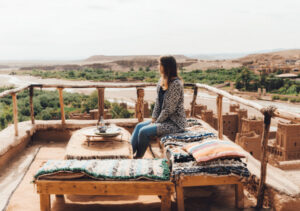
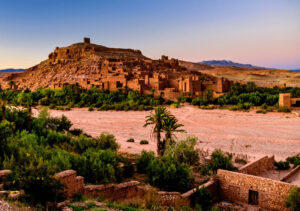
Ait Ben Haddou is a ksar — a fortified earthen village traditionally used as both a permanent settlement and a defensive structure — located in the Ounila River valley, approximately 30 kilometers northwest of Ouarzazate in southern Morocco. It represents the finest surviving example of ksar architecture in the pre-Saharan regions of Morocco, combining defensive towers (ksour), grain storage facilities (agadirs), a mosque, a Jewish quarter, and residential buildings in a single unified mud-brick complex.
The village is built entirely from the local red-ochre clay, mixed with straw and water to create pisé (rammed earth) — a building technique that has been used in southern Morocco for thousands of years and produces structures of extraordinary visual beauty and surprising structural durability, provided they are maintained against the rain. Much of the original ksar has been restored and is now protected under the UNESCO designation awarded in 1987.
History
Ait Ben Haddou’s origins are ancient. The site sits on one of the historic trans-Saharan caravan routes — the road connecting Marrakech with Timbuktu via the Draa Valley and the Sahara — and was used for centuries as both a trading post and a fortified refuge along the way. Salt, gold, spices, and enslaved people all passed through or near the ksar at various points in its long history.
The village reached its peak population and prosperity in the 17th and 18th centuries, when the southern kasbahs and ksour were at the height of their strategic importance. Today, only a handful of families remain living within the original ksar walls; most inhabitants of the Ait Ben Haddou area have relocated to the modern village on the opposite bank of the Ounila River. The ksar is maintained primarily as a heritage site, though several families continue traditional craft production within its walls.
Ait Ben Haddou in Film and Television
No cultural site in Morocco — and arguably in all of Africa — has appeared in more major film and television productions than Ait Ben Haddou. Its combination of ancient architecture, dramatic natural setting, and proximity to Ouarzazate’s Atlas Film Studios has made it the default location for productions requiring ancient Rome, Jerusalem, Egypt, Persia, or any number of fictional ancient civilizations.
Major productions filmed at or near Ait Ben Haddou include:
- Lawrence of Arabia (1962) — David Lean’s epic, though much was shot elsewhere in Morocco
- The Man Who Would Be King (1975)
- Jewel of the Nile (1985)
- The Last Temptation of Christ (1988)
- The Mummy (1999)
- Gladiator (2000) — the slave city of Zucchabar was built on the hillside above the ksar
- Alexander (2004)
- Kingdom of Heaven (2005)
- Babel (2006)
- Prince of Persia: The Sands of Time (2010)
- Game of Thrones (2011–2019) — Yunkai and other cities of Essos were filmed here
- Exodus: Gods and Kings (2014)
Your guide will point out the specific filming locations within and around the ksar — the hillside where the gladiator arena was constructed for Gladiator, the gateway used as Yunkai’s slave city in Game of Thrones, and the valley floor where entire ancient cities have been built and demolished over the decades.
What to See Inside the Ksar
The main gateway — the entrance to the ksar from the river crossing — is the most-photographed element of Ait Ben Haddou, and rightly so. The proportions of the towers, the textured surface of the mud brick, and the framing of the gateway arch make for a composition of extraordinary architectural beauty.
The residential towers — climb as high as the access allows. The upper levels of the tallest towers offer panoramic views over the Ounila Valley that are among the finest in all of southern Morocco.
The agadir (communal granary) at the very top of the ksar is the oldest surviving structure on the site and offers the best viewpoint of the entire complex. The climb is steep but short.
The active households — several families still live and work within the ksar, and several of the ground-floor spaces function as small workshops or craft shops. Potters, weavers, and painters work here and are generally happy to chat if you’re interested.
The Jewish quarter — Ait Ben Haddou historically had a significant Jewish population, as did many of the trading communities along the trans-Saharan routes. The architecture of the Jewish quarter is subtly different from the Berber and Arab sections — look for the distinctive geometric patterns carved into the doorways.
Practical Visitor Information
Getting there: Ait Ben Haddou is 32 kilometers northwest of Ouarzazate on a well-paved road. It is a standard stop on all 3 day desert tours from Marrakech and longer southern Morocco itineraries. There is no public transport to the ksar itself — you need a private vehicle or organized tour.
Opening hours: The ksar is accessible daily from approximately 8:00 AM to sunset. There is no formal closing time — it is an inhabited settlement as much as a tourist site.
Entrance fee: Approximately 10–15 MAD (around €1–€1.50) paid at the river crossing. Some guided tours include this in their fee.
Time needed: Allow a minimum of 1.5 hours for a proper visit; 2–2.5 hours if you want to climb to the top of the agadir and explore the lesser-visited upper sections at a relaxed pace.
Best time of day: Early morning (before 9:00 AM) or late afternoon (after 4:00 PM) for the best light and the smallest crowds. Midday in peak season can be very busy and the light is harsh for photography.
Guided vs self-guided: The site is walkable without a guide, but a knowledgeable local guide transforms the experience enormously — particularly for the film history, the architectural details, and the stories of the families who still live inside the walls.
Tips for Visiting Ait Ben Haddou
- Wear comfortable walking shoes. The paths inside the ksar are uneven earthen tracks; sandals or flat-soled shoes can be slippery on the steeper sections.
- Bring water. There are small shops inside the ksar but no cafés or restaurants within the walls.
- Cross the river on foot. Depending on the season, the Ounila River can be crossed via stepping stones or a footbridge. In winter and early spring after rainfall, water levels can make the crossing interesting — wear waterproof shoes or be prepared to remove them.
- Don’t feel obligated to buy from every craft stall. The ksar has a healthy number of vendors. Browse happily, buy what you love, but don’t feel pressured — a polite “shukran” (thank you) is always sufficient.
- Respect the families who live here. This is a real community, not just a tourist attraction. Ask permission before photographing people, avoid entering private residential spaces without invitation, and treat the ksar as the living heritage site it is.
How to Include Ait Ben Haddou in Your Morocco Itinerary
Ait Ben Haddou sits naturally on several key Morocco tour routes:
- 3 Day Desert Tour from Marrakech to Merzouga — Day 1 stop on the way to Dades Valley
- 4 Day Marrakech to Fes via Sahara — Day 1 stop before Boumalne Dades
- 5 Days Morocco Itinerary from Marrakech — Day 1 stop paired with Telouet Kasbah
- 6 Day Morocco Tour from Marrakech — Day 1 anchor stop before the Roses Valley
It is also available as a day trip from Marrakech combined with Ouarzazate, though a day trip doesn’t allow the time to fully appreciate the ksar and its surroundings.